 Glowproof
How to stick to a skincare routine without making it a chore
To stick to a skincare routine, keep it short, attach it to something you already do, make the products easy to reach and track it with a simple checklist. Allow missed days without guilt. Habits take time to form, with a median of 66 days in one often-cited study, so give yours a couple of months.
Coming soon to iPhone
Why do routines fall apart?
Most fail for ordinary reasons: too many steps, products stored out of sight, no clear time to do it and a feeling that a missed day ruins everything. None of these is about willpower. They are design problems with practical fixes.
It also helps to know how long habits take. The Wikipedia article on habit reports that Lally and colleagues found the average time to reach automaticity was 66 days, with a range of 18 to 254 days. That means a routine that still feels like an effort in week three is normal.
Habit 1: Shorten the list
Cut the routine to the steps you would still do on your worst day. Three is a good number. A sixteen-step routine is a plan for the week you have energy, and the other weeks it becomes none. You can always add later. Removing steps from a routine you never finish does more for consistency than any reminder.
Habit 2: Attach it to a cue
Wikipedia lists a context cue as one of the four main parts of habit formation, alongside craving, repetition and reward. A cue is something that already happens every day: brushing your teeth, taking off your shoes, switching off the light. Do the skincare step right after it. The old habit launches the new one, so you do not have to remember.
Habit 3: Put the products where the cue happens
Keep morning items next to the sink and night items next to the bed if you do your routine there. A product in a drawer in another room is a product you skip when you are tired. A small tray with the day's items is enough.
Habit 4: Make the first step easy
The hardest moment is starting. Make the first step the simplest: a face wash you can use half asleep. Once that is done, the rest tends to follow. If starting is still hard, set a rule of one step only on bad days. A one-step day still counts.
Habit 5: Track with a plain checklist
A checklist makes the invisible visible. Tick each step as you finish it, and look at the week at the end. A count such as 4 of 6 is information. Resist turning it into a score. The goal is to see what you really do, so that you can adjust the routine to fit.
Habit 6: Plan for missed days
You will miss days, so decide in advance what happens. The rule can be simple: if you miss a day, do the next one as normal and do not double up. Skipping a night does not undo a month. The guilt of a missed day is a stronger reason people quit than the missed day itself.
Habit 7: Add a reward that is not a purchase
Reward the habit with something small and free: a minute of quiet, a favorite song, a look at your progress photo. Buying a new product as a reward leads to a longer routine, which makes the habit harder to keep.
Habit 8: Review monthly
Once a month, look at the checklist and the photos. Ask what you keep skipping and why. Remove or move that step. Ask what you enjoy and keep it. The review is how a routine turns from a list someone told you to follow into one that fits your life.
How does Glowproof help?
Glowproof, an iPhone skin photo diary in development, has a morning and night checklist built from the steps you add, with reminders you control. Reminders are optional and scheduled on your iPhone, the app sends at most 2 a day, and the Today screen shows a plain count such as 4 of 6 this week. The app states that these are counts and not a score. If you delete a step, your past check-offs stay in the counts. See routine and Product Trials.
What if you travel or your schedule changes?
Pack a mini version of your routine: cleanser, moisturizer and sunscreen in small containers, in a bag that stays packed. A routine that works only at home will fail on the first trip. Keep the cue the same: do it right after brushing your teeth, wherever you are. When time zones or shifts change your day, attach the routine to waking up and going to sleep, not to the clock.
How do you handle the days you do not feel like it?
Lower the bar to the smallest version. Splash with water, put on moisturizer, go to bed. Write the minimum on a card so that you have a pre-decided answer: tired night means cleanser and moisturizer, nothing else. On those days the point is to keep the habit alive, and the full routine can return the next day. People who quit usually did so after a perfect week and then a missed night, not after a bad routine.
What should you do when you get bored?
Boredom is a signal that the routine has become automatic, which is the goal. Resist the urge to add products as a cure. If you want novelty, change something that costs nothing: do the routine in a different order of comfort, try a new playlist or swap the time. If you do want to try a product, run a proper trial with a start date and a single change, as in the guide to trying a new product.
How do you involve other people?
Tell one person what you are trying, or do it alongside a partner or roommate. Social support is a gentle form of accountability. You do not need to share details or photos. A message such as I am doing my routine every night this month is enough. If you share a bathroom, agree where products live so that the setup stays easy for both of you.
Frequently asked questions
How long does it take to build a skincare habit?
It varies. One often-cited study found a median of 66 days to reach automaticity, with a range from 18 to 254 days.
How many steps should a skincare routine have?
As few as you will do on a bad day. Three is a common starting point.
What if I forget to do my routine at night?
Do it the next night and do not double up. One missed night does not undo a month.
Should I set reminders?
Reminders help at first. Choose one time a day, not several, and remove ones you ignore.
Does a checklist count as a score?
It should not. Treat the count as information about what you do, not as a grade.
Keep exploring
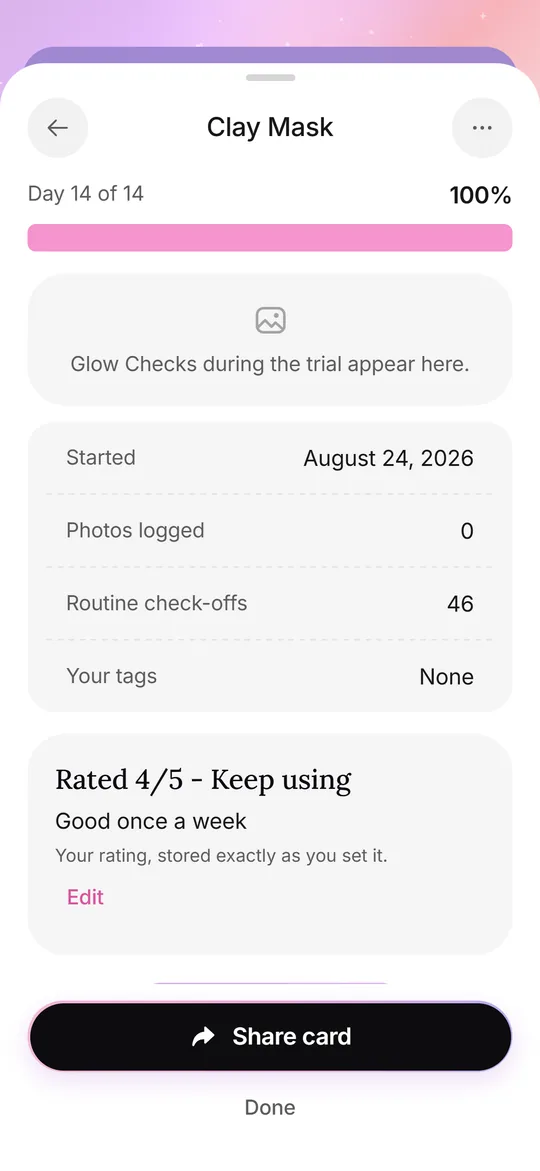 Routine and trialsYour own AM and PM checklist, reminders, and 14, 28 or 42 day Product Trials.Skincare Bullet JournalTen bullet journal layouts for tracking skincare, with what each page is for and when to use an app for the photos.