 Glowproof
Skincare bullet journal ideas: ten layouts that stay simple
A skincare bullet journal works best with a few plain layouts: a routine checklist, a skin-feel calendar, a product trial page and a photo log. Draw each in about five minutes, update it in thirty seconds, and keep the pages private. Skip anything that looks lovely but never gets filled in.
Coming soon to iPhone
What is a skincare bullet journal?
A bullet journal is a paper organization system developed by Ryder Carroll and shared publicly in 2013, according to Wikipedia. It uses short bullet points and flexible layouts. A skincare version applies the same idea to routines, products and how your skin feels, with pages you design yourself.
Search results are full of watercolor spreads. Those are fun, and they are also the quickest way to abandon a journal, because every page feels like a project. The layouts below favor plain boxes and short words. You can decorate later if you still want to.
Layout 1: The routine checklist
Draw a grid with the days of the month across the top and your steps down the side, split into morning and night. Tick a box when you finish a step. At month end, count the ticks. It shows at a glance which steps you skip. Keep the list to what you actually use.
Layout 2: The skin-feel calendar
A month of small squares, one per day. Color or letter each square with a word for how your skin felt: calm, oily, dry, breaking out, sensitive or irritated. Use the same code every month. After a few months you can see patterns across weeks, and the calendar is quick to fill in because it asks for one word.
Layout 3: The product trial page
One page per product. Write the name, start date, planned length and the one thing you hope to notice. Add a row of boxes for each day and a space for a verdict and a 1 to 5 rating at the end. The guide to how long to try a new product suggests 14, 28 or 42 days.
Layout 4: The photo log
Paste small printed photos or draw a box for each week and write the date of the photo you took. If you take photos on your phone, keep them there and use the page for dates and notes. A grid of dates reminds you when you last took a photo and in which light.
Layout 5: The context tracker
A small table for things that might affect your skin and mood: sleep, stress, travel, period, new product. Mark a dot on the days it applies. You are not trying to prove a link. You are collecting context so that a rough week is not automatically blamed on a product.
Layout 6: The shelf page
A list of everything you own, with the date you opened each product and the period after opening printed on the pack, if there is one. The period-after-opening symbol shows how long a cosmetic can be used after it is first opened. A shelf page stops you from keeping things you no longer use.
Layout 7: The wish list
Products you are curious about, with the reason. Trim it every quarter. A reason like a friend swears by it fades quickly, and the list shows you what you still want.
Layout 8: The weekly review
Five lines on Sunday: what I did, how my skin felt, what changed, what I will keep, what I will drop. It takes two minutes and gives each week a closing note.
Layout 9: The empties page
A page where you note finished products and a one-word verdict: repurchase, no, maybe. It builds a record of what you actually liked, as opposed to what you bought.
Layout 10: The seasonal page
At the start of each season, write what you changed in the routine and why. Look back a year later. It is the page you will thank yourself for.
Where does paper stop being enough?
Paper is good for words and habits and poor for photos. Comparing two selfies from different weeks needs both images at the same size, and judging whether the light matched is hard by eye. Glowproof, an iPhone skin photo diary in development, handles that part: a daily Glow Check with a light check against your Day 1 photo, and side by side comparison with dates. Photos stay on the iPhone, with no account, and your notes and tags are yours. See side by side comparison.
Using both is common. Keep the journal for routine and reflection, and the app for photos.
How do you start without overspending?
You need a notebook, a pencil and one pen. Dotted pages help with grids, but plain paper works. Skip the stencils and stickers until the habit holds. Start with layouts 1, 2 and 3, and use them for a month. At the end of the month, ask which page you opened most and which you skipped. Drop the skipped ones and keep the rest. A journal that evolves from use fits better than one planned in advance.
How do you keep it private and tidy?
A skin diary is personal. Keep the journal in a drawer or a bag, and avoid leaving it open on a desk. If you write product names, you may prefer short codes for products you are testing. Use one page per month for routine, and one page per trial for products, so that a page can be torn out or photographed without exposing everything else. Tidy does not mean pretty. It means you can find the page you want in ten seconds.
What should you not put in a skincare journal?
Skip anything that turns notes into a verdict on your face. Words like bad skin day or ugly tend to color the whole month. Prefer neutral words: dry, oily, red patch on cheek, new bump on chin. You can add feelings in a separate line if you wish. The aim is a record you can read calmly later, with the same eyes you would use to read a friend's notes.
Frequently asked questions
What should I track in a skincare bullet journal?
A routine checklist, a skin-feel calendar, product trial pages and a photo log cover most needs.
How do I start a skincare journal?
Draw a simple monthly grid for your routine and a calendar for how your skin feels. Add other pages once these feel easy.
Can I put photos in a bullet journal?
Yes, as small prints, but many people keep photos on the phone and write dates and notes on paper.
How do I keep a journal private?
Keep it in a drawer or bag, and avoid photographing pages with personal details.
Is a paper journal better than an app?
Paper suits habits and reflection. An app suits photos and comparisons. Many people use both.
Keep exploring
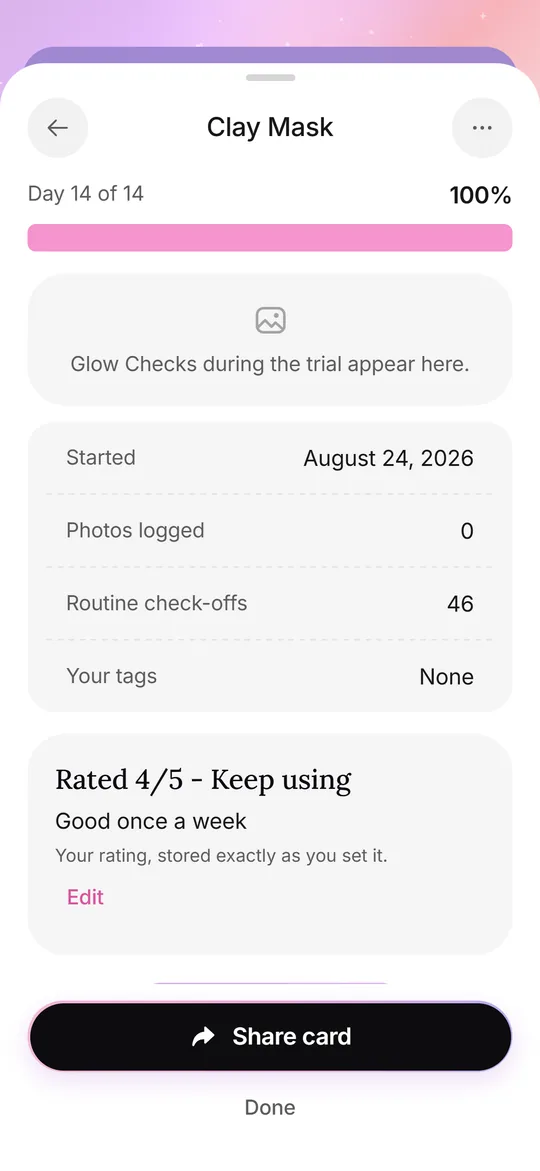 Routine and trialsYour own AM and PM checklist, reminders, and 14, 28 or 42 day Product Trials.