 Glowproof
Skincare journal ideas: what to write down and how
A skincare journal works best as a five-line daily entry plus a short weekly look back. Write the date, what you used, how the skin feels in your own words, anything unusual such as travel or poor sleep, and attach a photo. Keep it short enough that you will do it.
Coming soon to iPhone
What is a skincare journal?
It is a diary of your routine and how your skin feels, kept so you can look back. People search for skincare journal ideas, a skincare journal template and a daily skincare journal, and the common wish is the same: stop forgetting what changed and when. A diary is an old tool for exactly this, a dated record in your own words (Wikipedia: Diary).
A journal records. It does not explain. The explanations are yours to make, and for health questions a professional is the right source.
The format is flexible. Some people keep a page per week. Others use a grid with one row per day and one column per step. Choose the one that takes the least effort, because effort is what ends diaries, long before a lack of ideas does.
Starting costs nothing. The date and one line is a valid first entry.
What goes in a daily entry?
Five lines are enough. Add or drop lines to fit your life.
If five lines feel like too much, keep two: what you used and one word for how it feels. A short entry made every day is worth more than a rich entry made twice a month. You can always add detail on days that matter.
Write in the past tense and stick to facts. Used the new serum is a useful entry. A guess about what it is doing to you belongs in a question for a professional.
- Date and time of day.
- Steps and products you used, as written on the label.
- How your skin feels, in a word or two.
- Anything unusual: travel, poor sleep, stress, a new product, your cycle.
- A photo, taken the same way each time.
How should I describe how my skin feels?
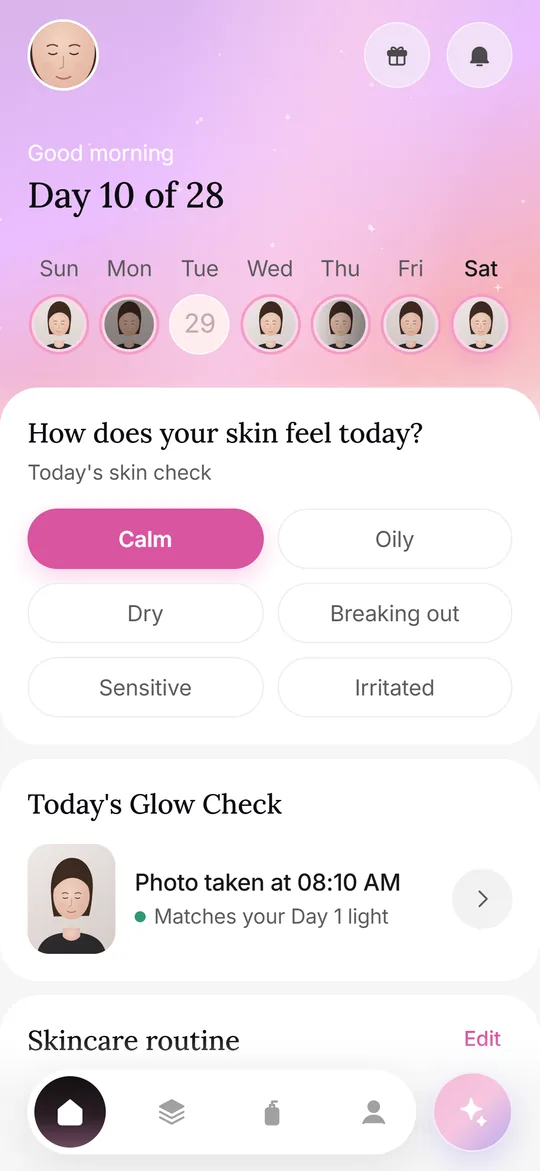
Use a short, fixed set of words so entries stay comparable. A set like calm, oily, dry, breaking out, sensitive and irritated covers most days, and Glowproof offers exactly these as tap-to-select options. A fixed list beats free-form prose when you read back through a month, because the same word means the same thing every time.
Write what you notice, and leave out diagnoses and guesses. If you are unsure about something, note the date so you can ask a health professional about it.
Resist rating the skin with a number. A score out of ten asks you to judge, and your standards drift over weeks. A word like dry or calm records a state, which is easier to repeat honestly.
What do I do with the weekly look?
Once a week, read the last seven entries and write one sentence. What did you change? What stayed the same? Does anything line up with the notes about sleep or travel? Then put the sentence at the top of the next week.
Compare photos only on set days, such as Day 7, Day 14 and Day 28. The rhythm guide explains why daily comparisons mostly show the weather.
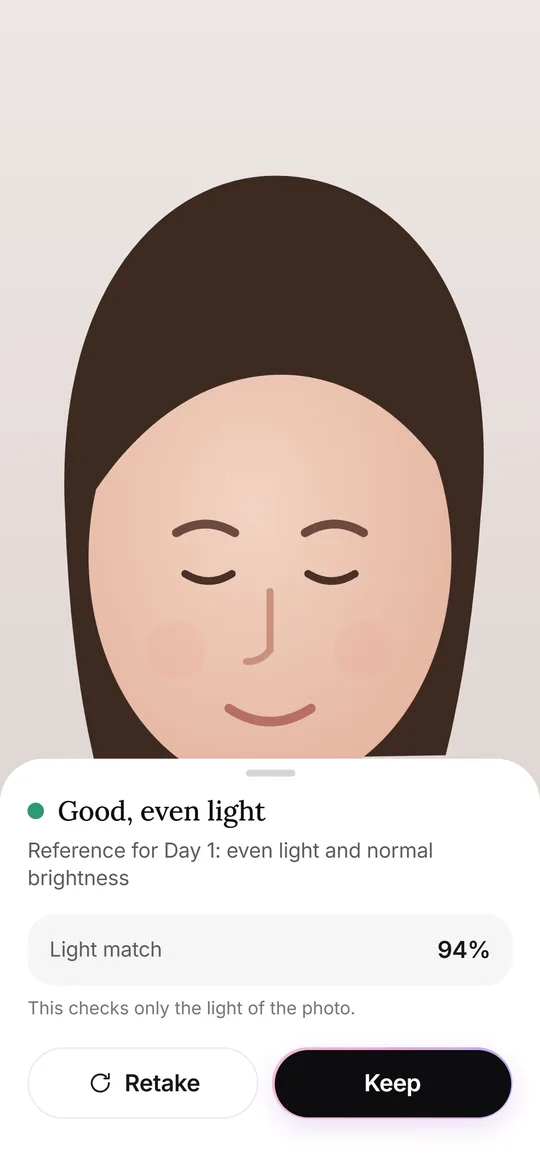
Tie the journal to the photo so it keeps going. If the photo is the daily anchor, the entry takes ten seconds more. Glowproof puts the feel options, tags and note on the screen that appears right after the photo is saved, so there is no second trip to another app. Allow gaps without comment, and review the journal monthly, trimming any line you never use.
A good weekly sentence names a fact with a date, such as the serum started on Tuesday and two travel days fell mid-week.
- Read the last seven entries in order.
- List what changed in the routine, with dates.
- Write one sentence about what you noticed.
- Decide whether to keep going unchanged or to change one thing.
What does a sample week look like?
Here is a plain example of how a few days might read. Monday, morning: cleanser, moisturizer, sunscreen, felt calm, photo taken. Tuesday, night: added a new serum for a 14-day trial, felt calm, tag new product. Wednesday: flight, felt dry, tag travel, photo in hotel light, flagged as different light. Sunday: read the week, wrote one sentence, decided to keep going.
Notice what is missing: theory, causes and scores. The entries only say what happened. Patterns, if they exist, show up when you read many of them in a row.
How do I log a new product?
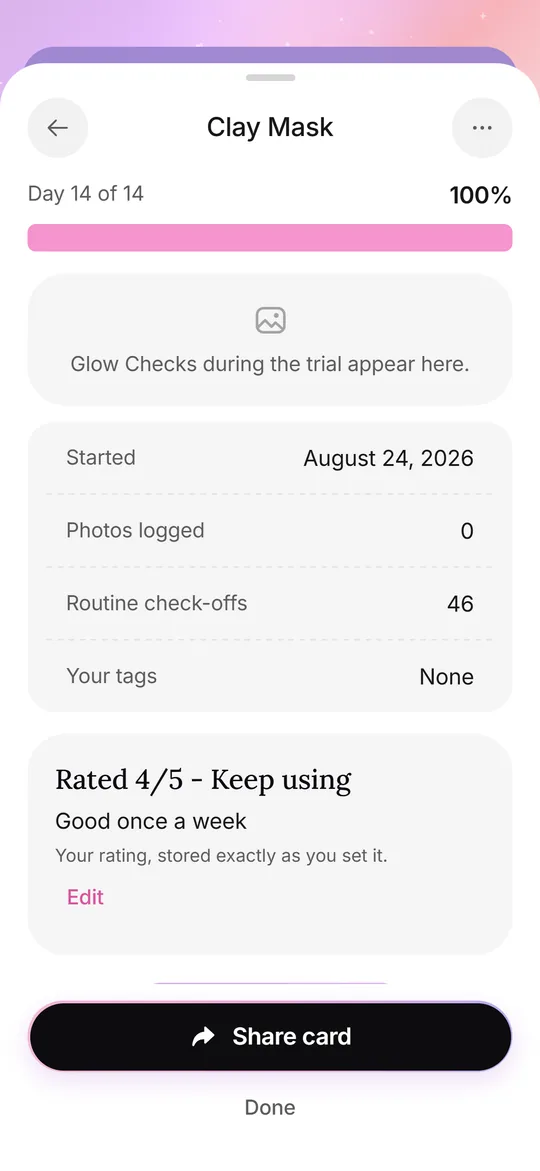
Start a product log with the name, the date you began, the area you use it on and how many days you plan to test it. Change one thing at a time, so that a change in how you feel can be tied to a single date. Fourteen, 28 or 42 days are common test lengths, and they are the options in Glowproof's Product Trials.
At the end, give it your own rating, from 1 to 5, and a keep or drop decision. Nobody else needs to agree with it. See Product Trials for how the app handles this.
Write the name exactly as on the label, since brands change names and formulas. When the trial ends, file the entry with the date in the same place as the others.
If something stings or feels off, write the date and what you used. For anything that worries you, ask a pharmacist or a doctor rather than the diary.
Which tags are worth reusing?
A small set of context tags is more useful than many. Good candidates are new product, poor sleep, travel, stress and period, which are the ones Glowproof provides. Tag the day, not the face, and the pattern you find later will be a pattern in your life as much as in your photos.
Retire a tag when it stops being useful. If you tag every day as stress, the tag says nothing. Add a new one only when you catch yourself writing the same phrase three times in your notes.
| Tag | Why it helps |
|---|---|
| New product | Marks the date a product entered the routine |
| Poor sleep | Lets you check whether bad days cluster after short nights |
| Travel | Flags changed climate, water and routine |
| Stress | Notes a hard week without judging it |
| Period | Notes your cycle in your own record |
Paper, notes app or a photo diary app?
Any of them works. Paper is private and slow to search. A notes app is quick but separates words from photos. A photo diary app keeps them together. The next guide compares the options in skincare tracker app vs paper journal.
Whichever you pick, put it where you already look every day. A notebook on the bathroom shelf beats a nicer one in a drawer.
Frequently asked questions
How long should a daily skincare journal entry be?
Five lines or about a minute. Short entries survive busy weeks, and long ones tend to stop.
Should I take a photo every time I write an entry?
A photo helps, if you can take it the same way each time. Without a fixed setup, photos add noise, so a written note alone is better.
What should I leave out of a skincare journal?
Diagnoses and guesses about causes. Write what you did and what you noticed, and ask a qualified professional about medical questions.
Does Glowproof analyze what I write?
No. Your notes, tags and ratings are stored on your iPhone and shown back exactly as you entered them.
Keep exploring
 Photos at homeA repeatable home setup: spot, light, distance, angle, timing and a Day 1 reference.
 Routine and trialsYour own AM and PM checklist, reminders, and 14, 28 or 42 day Product Trials.
 Glow CheckThe daily photo: guide, light check, your feel, tags and notes.