 Glowproof
How often should you take skin progress photos?
Take a photo as often as you can keep doing it, and compare at longer gaps. A daily photo builds the habit and gives you options, while comparisons every 7, 14 or 28 days keep you from reading noise. Consistency of time, place and light matters more than the exact rhythm.
Coming soon to iPhone
What is the short answer?
Choose a rhythm you will still follow in two months. For many people that is one photo a day, taken at the same moment as a morning routine. Others do twice a week. Both work for a diary, because the useful part is the pile of comparable photos you have later.
The rhythm for looking is different from the rhythm for shooting. You can photograph daily and compare only on set days. Glowproof follows that split: a daily Glow Check and side by side screens at Day 7, Day 14 and Day 28, then every 28 days. These dates are the app's own convention for pacing, not a medical rule.
If you are unsure, start with daily for two weeks. It shows you how much the light varies at your spot, and then you can drop to a lighter rhythm with real information.
What do people actually search for?
Many people ask how often to take progress pictures. Most of that question comes from fitness, and the answers there transfer to a skin diary in one respect: the habit is the hard part.
Skin photos have an extra problem. Light, angle and distance change between shots, and the changes can be bigger than anything happening on the face. That is why the rhythm question and the lighting question belong together. The lighting guide covers the second half.
There is a practical reason to ask the question early. Without a stated rhythm, most diaries start with a burst of daily photos, fade after ten days and leave two weeks of dense data followed by random single shots. A rhythm you wrote down in advance prevents that shape.
How do daily, twice-weekly and weekly photos compare?
Each rhythm trades effort against the number of usable photos. A table makes the trade clear.
Whatever you pick, write it at the top of your notes with the date you began.
| Rhythm | Strength | Weak spot |
|---|---|---|
| Daily | Many photos, so some will match in light. Easy to tie to a routine. | Easy to skip a day and feel you failed. More photos to sort. |
| Every 2 to 3 days | Lower effort, still plenty of photos. | Fewer matching shots in bad weather. |
| Weekly | Simple and low pressure. | A few unlucky photos can spoil a month of comparisons. |
| Monthly | Almost no effort. | Too few photos to judge light or find a fair pair. |
How do I choose between daily and weekly?
Ask three questions. Do you already have a daily anchor, such as a morning routine? Do you have good window light at the time you would shoot? Will you feel guilty about a missed day? Yes to the first two and no to the third point to daily. Otherwise start weekly and add a second day if it feels easy.
A fair test is to run your chosen rhythm for four weeks and count the photos you took and the photos you would use. If you used fewer than half, change the rhythm or the setup, not your willpower.
Why does a habit beat a perfect schedule?
A study by Phillippa Lally and colleagues at University College London followed 96 people as they built a new daily habit. The time it took to reach automatic behavior varied widely, from 18 to 254 days, with a median of 66 days, and missing a single day did not derail the process (Lally et al., 2010). The practical reading for a photo diary is to attach the photo to something you already do, and to treat a missed day as a gap, not a reset.
A fixed anchor helps. Right after washing your face, in front of the same window, is easier to remember than at some point in the day.
That gives you permission to start small, such as three photos a week, and still be on track.
When should I compare photos?
Compare on set dates and not every evening. Daily comparisons mostly show the effect of that day's light, sleep and mood. Glowproof offers Day 7, Day 14 and Day 28 moments for this reason, and you can compare any two dates with Pro.
Skin changes at its own pace and differs from person to person, and this guide cannot tell you what to expect. A comparison gap of a few weeks simply gives you a long enough view to look at. If you are worried about a change, a doctor or dermatologist is the right person to ask.
After Day 28, keep shooting at the same rhythm and look back at set intervals. A monthly side by side of the same two points in the month, such as the first and the last day of a calendar month, gives a regular view without much effort. Change the interval only when you change something else on purpose, and write it down.
A long diary is the point of the exercise. After a few months, a pair of photos from the start and from now is a very different object from a pair from last Tuesday and this Tuesday.
- Take photos at your chosen rhythm for the first week without comparing.
- On Day 7, look at Day 1 and Day 7 side by side and write one sentence in your own words.
- Repeat at Day 14 and Day 28 with the same format.
- After Day 28, keep a monthly look, and a longer one when you change something in your routine.
What should stay the same between photos?
Four things: place, time of day, light and distance. If you change your routine, change only one thing at a time so the diary can show when it happened. Write the date and the change in a note.
Glowproof stores these details with each photo, so you do not have to remember them. Tags such as New product, Poor sleep or Travel are yours to add. The app reads nothing from your face to fill them in.
A short written setup helps more than people expect. Put it in your notes: spot, window, hour, distance, hair and makeup. When a photo looks off, you can compare it with that list and find the difference.
What if I miss days?
Take the next one. A gap makes the diary a little less dense and does not ruin it. Glowproof shows streaks as plain counts and sends at most 2 reminders a day. If reminders feel like pressure, turn off the ones you do not need in Me, Reminders.
After a long break, resume with the same setup and do not try to catch up. One photo today is worth more than a plan to take ten.
Frequently asked questions
Is it better to take skin photos every day or every week?
Either works if you keep doing it. Daily photos give more chances of matching light, while weekly photos are lower effort. Compare on set dates, not after every shot.
How long should I wait before comparing skin progress photos?
A gap of a few weeks gives a clearer view than a few days. Glowproof offers Day 7, Day 14 and Day 28 comparisons as pacing points, not medical benchmarks.
What time of day is best for progress photos?
The same time each day. Many people use the morning, right before or after their routine, in front of a window.
Can this guide tell me if my skin is improving?
No. It covers how to take comparable photos. For questions about your skin, ask a qualified health professional.
Keep exploring
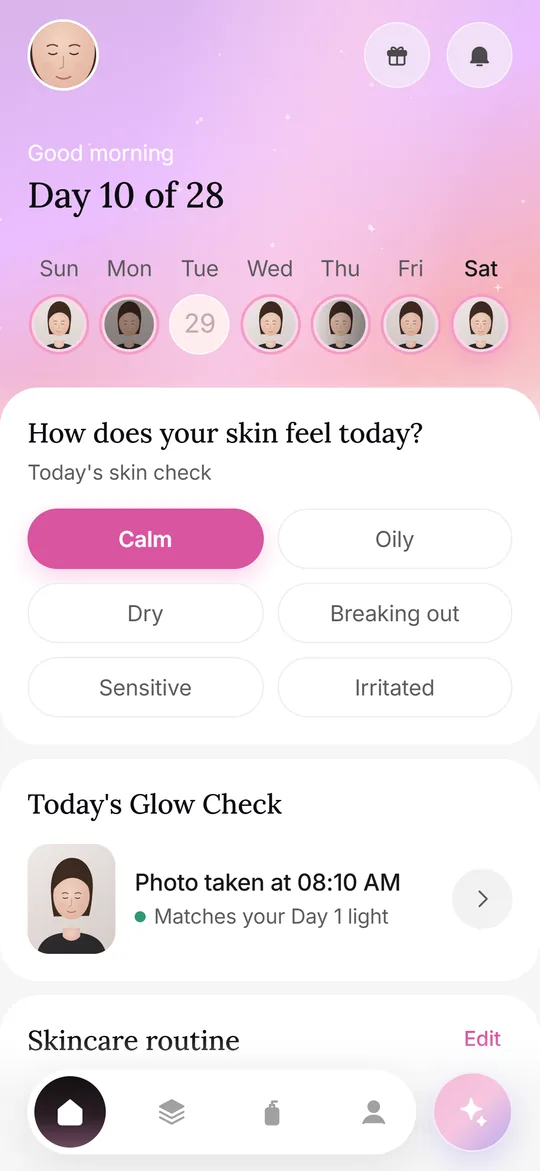 Photos at homeA repeatable home setup: spot, light, distance, angle, timing and a Day 1 reference.Side by sideSlider or split compare, Day 7 and Day 28 moments, and old selfie vs today.
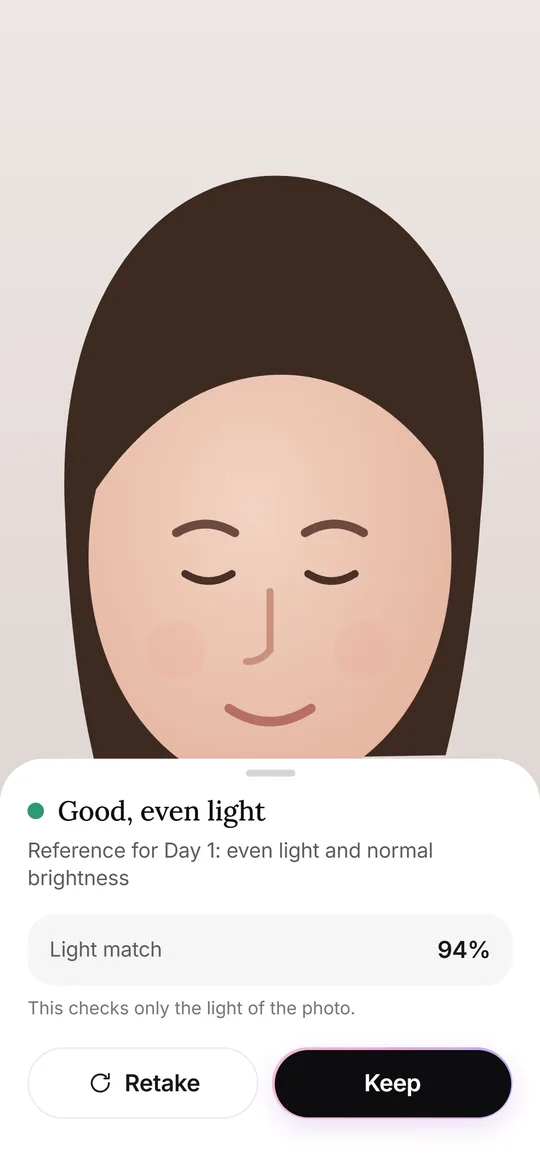 Glow CheckThe daily photo: guide, light check, your feel, tags and notes.