 Glowproof
Korean skincare routine steps: the ten-step order and a short version
The ten-step Korean skincare routine usually runs: oil cleanser, water cleanser, exfoliator, toner, essence, serum or ampoule, sheet mask, eye cream, moisturizer and, in the morning, sunscreen. Most people do not use every step daily. A short version of cleanser, moisturizer and sunscreen is a sensible start.
Coming soon to iPhone
What is the Korean skincare routine?
It is a layered approach associated with K-beauty, the umbrella term for skincare products derived from South Korea. Wikipedia's article on K-beauty says the focus is on health, hydration and brightening, and that a lengthy regimen is preferred, with a focus on toning and clarifying. The regimen involves cleansing, sheet masks, essences, serums, moisturizers and sunscreen, and at night sunscreen is replaced by a night cream.
The famous ten-step version is a popular way to describe it. It is a framework, and in practice the number and order vary by person and brand.
What are the ten steps?
Notice how many steps are occasional or optional. The ten steps describe a menu, not a daily chore.
| Step | What it is | Daily? |
|---|---|---|
| 1. Oil cleanser | Removes sunscreen and makeup | Evening |
| 2. Water cleanser | Second cleanse | Morning and evening |
| 3. Exfoliator | Scrub or chemical exfoliant | Occasionally |
| 4. Toner | Prepares the skin | Often |
| 5. Essence | A light hydrating liquid | Often |
| 6. Serum or ampoule | Targeted treatment | Optional |
| 7. Sheet mask | A short mask treatment | Occasionally |
| 8. Eye cream | For the eye area | Optional |
| 9. Moisturizer | Seals in the layers | Daily |
| 10. Sunscreen | Final morning step | Morning |
Why is the double cleanse in there?
Oil cleansers are meant to lift oil-based products such as sunscreen and makeup, and the water-based cleanser takes away the rest. The pairing is called a double cleanse. If you do not wear makeup or heavy sunscreen, one gentle cleanse may be enough. Pay attention to how your skin feels after washing.
How many steps do you need?
Fewer than ten. A short version has three steps: a gentle cleanser, a moisturizer and, in the morning, sunscreen. A medium version adds a toner or essence and a serum. A long routine means more products to introduce, more to track and more chances that something does not suit you. The guide to building a routine from scratch shows how to grow it slowly.
How do you add steps safely?
One at a time, with a trial. Add an essence, run it for 14 to 28 days, keep the rest steady, and judge it. If it suits you, keep it. Then consider the next step. Patch test first, and follow labels, especially for exfoliants and active products. If you have a skin condition, ask a dermatologist about layering.
How do you track a long routine?
A checklist with the steps in order and a tick per day. A routine with seven steps and two sessions a day has 14 boxes a day, which is a lot. Group the steps into morning and night, and note only the ones you skip. Use a weekly view to see patterns. Do not turn the checklist into a score.
How does Glowproof handle a long routine?
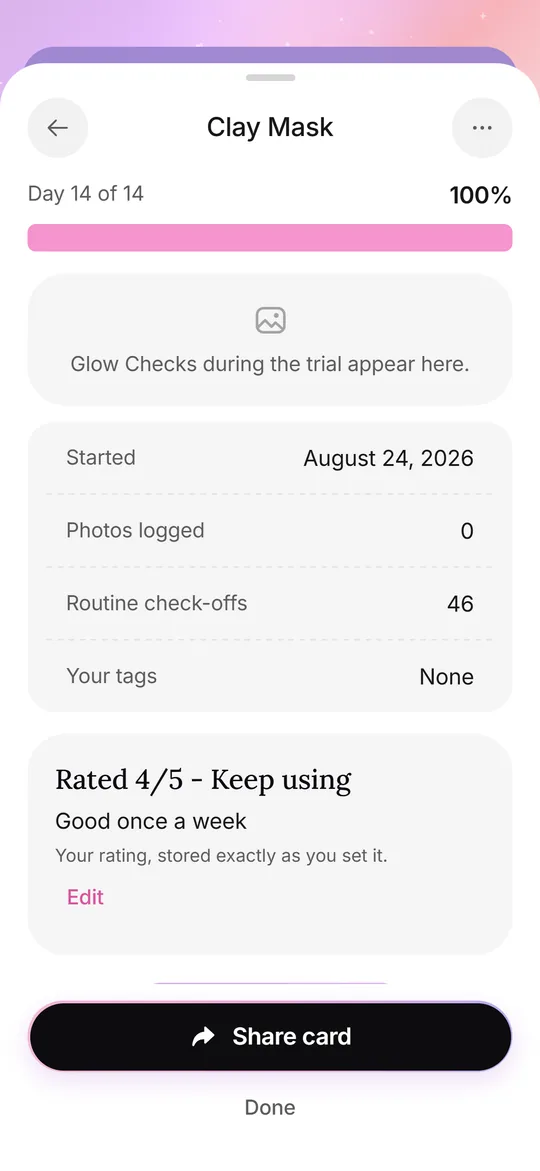
Glowproof, an iPhone skin photo diary in development, lets you add steps in the order you do them, each with a type, an optional product name, a time of day and the weekdays it applies. Types include Cleanser, Toner, Serum, Treatment, Moisturizer, Sunscreen, Eye and Other, so an essence or a mask can go under Serum, Treatment or Other. You tap a step to check it off, and the Today screen shows a plain count, such as 4 of 6 this week, which the app says is a count and not a score. The app suggests no products. See routine and Product Trials.
Where did the layered routine come from?
K-beauty grew into a global category, and Wikipedia says it became popular in East Asia, Southeast Asia, South Asia and the Western world. The idea of a lengthy regimen with many light layers matches a preference for hydration and for a luminous look. Brands package steps as a system, and social media spread the ten-step label. It is worth remembering that a marketing framework is not a rule of skincare.
What changes between morning and night?
In the morning the routine is lighter and ends with sunscreen. At night it starts with the oil cleanse to remove sunscreen and makeup, and ends with a moisturizer or night cream. Masks and exfoliants usually belong to the evening and a few days a week. The Wikipedia entry on K-beauty notes the night cream replacing sunscreen at night. If you are short of time, do a double cleanse only on days you wear sunscreen or makeup.
What is a medium routine?
Six steps are a reasonable middle ground: cleanser, toner or essence, serum, moisturizer, sunscreen in the morning and a night cream in the evening. You can build it in six weeks by adding one step at a time. Each addition gets its own trial, so you know what each one adds. If a step does nothing you can notice after a trial, drop it.
What are the common pitfalls?
Buying a full set at once, using exfoliants too often, layering products that were not meant to be combined, and judging a step by its first week. Another pitfall is following a routine from someone with different skin, climate and habits. A longer routine is also harder to keep, and the best routine is the one you do. Begin with the short version, and let curiosity, not pressure, decide the rest.
How do you shop sensibly?
Decide a budget and pick one step to try. Read labels, check the PAO symbol and the ingredient list, and look for returns or samples. Avoid stocking up on sets. When a product ends, wait a week before you replace it, and ask whether you missed it. Your log will answer that better than a sale will.
What about sheet masks and exfoliants?
They are the steps most likely to be overused. A sheet mask is a short treatment, used occasionally, and an exfoliant is not a daily product for many people. Follow the label, start with a low frequency and watch your skin. If it feels tight, red or stinging, pause the step. The guide to a patch test at home applies to every new product in the routine.
How do you build the routine slowly?
Plan six weeks. Week one, cleanser, moisturizer and sunscreen. Week two, a toner or essence. Week three, rest and observe. Week four, a serum. Week five, rest. Week six, decide about a mask or an eye product. This pace is slow on purpose, and it lets you see what each product adds. Log each change with a date and a photo in steady light, and rate each addition when you finish its trial.
What do you do with products you already own?
Use them in the order of the routine if they fit. A cleanser you own can be the water cleanser. A cream you own can be the moisturizer. There is no need to buy a branded set. Use what you have first and replace items as they finish. The order matters more than the label on the bottle.
Frequently asked questions
What are the steps of a Korean skincare routine?
Oil cleanser, water cleanser, exfoliator, toner, essence, serum, sheet mask, eye cream, moisturizer and sunscreen in the morning.
Do I need all ten steps?
No. Many are occasional or optional. Cleanser, moisturizer and sunscreen make a sensible short version.
What is a double cleanse?
An oil-based cleanser followed by a water-based one, used to remove sunscreen and makeup.
Is the Korean routine good for beginners?
Start with the short version and add one step at a time with a trial.
Can I track a long routine in Glowproof?
Yes. Add each step in order, with a type and weekdays, and check them off from the Today screen.
Keep exploring
 Routine and trialsYour own AM and PM checklist, reminders, and 14, 28 or 42 day Product Trials.