 Glowproof
Skincare product expiration: reading the PAO symbol and tracking dates
Many skincare products show an open-jar symbol with a number, such as 12M, which is the period after opening: how many months the product is intended to stay good once opened. Write the opening date on the product or in a log, count forward, and replace it when the time is up or when it changes.
Coming soon to iPhone
What does the open-jar symbol mean?
The period-after-opening symbol, or PAO symbol, identifies the useful lifetime of a cosmetic product after its package has been opened for the first time. It depicts an open cosmetics pot and appears with a number of months or years, such as 6M or 12M, according to Wikipedia. In the European Union, products with a shelf life of at least 30 months do not need a best-before date, and must show the period after opening instead.
So a jar marked 12M is meant to be used within 12 months of the day you first open it. A date printed with an hourglass or a best-before date is a different thing: it refers to unopened storage.
Where do you find it?
Look on the box and on the container, often near the batch code. Some small items have it only on the outer box, so photograph the box before you recycle it. If you cannot find the symbol, check the brand's website or the leaflet. Products sold in different regions may be labeled differently.
Why track opening dates?
Because memory is poor. Few people remember when they opened a serum, and most would guess too recent. A record turns a guess into a date. It also helps you notice how long you keep products you rarely use, which is a clue to what you can stop buying.
Tracking also makes trials cleaner. If you note the opening date at the start of a trial, you know exactly how long you have had it in use.
How do you track them?
Pick one of three simple methods.
In a spreadsheet, add the PAO months to the opening date with =EDATE(B2,C2), where B2 is the open date and C2 is the number of months. The result is the date to replace it by.
| Method | How | Good for |
|---|---|---|
| Marker on the product | Write the month on the bottom or the box | Fast, no tech |
| Shelf page in a notebook | List products, open date, PAO | A bird's-eye view |
| Spreadsheet row | Date opened plus PAO gives a replace-by date | Sorting and reminders |
What other signs say to replace a product?
A label is a guideline. Replace a product earlier if it changes color, smells different, separates, grows a film or irritates your skin when it did not before. Storage matters: heat, sunlight and a steamy bathroom shelf can age a product faster. Keep lids closed and use clean hands or a spatula. If you are unsure, ask a pharmacist.
What about sunscreen and active products?
Check the specific label and leaflet. Sunscreen and products with active ingredients come with their own guidance, and some have an expiry date that matters more than the PAO. If a sunscreen is past its date, replace it. This page is general information and not advice about any product.
How do you avoid waste?
Buy smaller sizes of products you are trying. Finish what you open before opening a similar one. Write a use-by month on the lid when you open it. A shelf page helps you notice duplicates before you buy another.
How does a skin diary help?
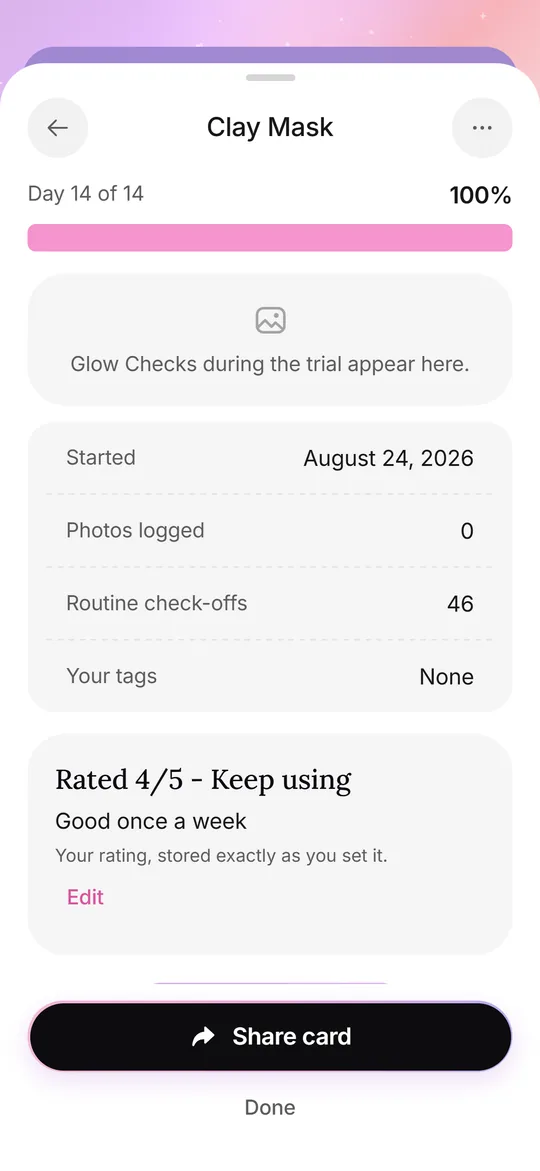
A diary that records products and trial dates gives you a natural place for opening dates. Glowproof, an iPhone skin photo diary in development, lets you log a Product Trial with a start date and length of 14, 28 or 42 days, and attach your own notes. The app suggests no products and does not track expiry dates, so keep the PAO date in your note for the trial or on the product itself. See routine and Product Trials.
What is the difference between expiry, best before and PAO?
Three labels appear on products, and they mean different things. An expiry date, common on sunscreens and some active products, marks the end of a product's intended life. A best-before date, often an hourglass or a date, refers to unopened storage. The PAO is the time after opening. When more than one is present, the shortest period governs. If a pack has a date that has passed, replace it regardless of the PAO.
How should you store skincare?
Keep products in a cool, dry place away from direct sun. A bathroom shelf is convenient and often warm and damp. If your bathroom steams after every shower, consider a drawer in the bedroom for items you want to last longer. Close lids fully. Do not leave products in a car. These habits cost nothing and may help products last as long as the label suggests.
Is it worth tracking every product?
Not always. Track the ones that are open for a long time or that are expensive, and ones you rarely use. A bottle of cleanser you finish in a month needs no log. A jar of cream you use twice a week may sit for a year. The log pays off where products last longest.
How do you use the log for decisions?
Look at the shelf page once a quarter. Any product past its replace-by date goes. Any product you have not used in three months gets a question: do I still want this? If the answer is no, donate it if it is sealed and unused, or recycle the packaging. A short, current shelf is easier to use and easier to keep consistent, which supports every trial you run.
What if a product has no PAO symbol?
Some small items and some regions have no symbol. In that case, rely on the date on the pack, the leaflet or the brand's website. A product with no guidance is a good candidate for a short trial and a modest purchase. Write the opening date on it anyway, and decide a personal limit, such as a year. If the product changes in smell, color or feel before then, replace it.
Can you test a product's age by smell and look?
Not reliably. Changes you can notice are a signal, but some changes are invisible. Treat sight and smell as a way to catch obvious problems, not as proof that an old product is fine. The date is the starting point, and your own reaction is the check. If your skin reacts to a product that used to suit you, stop using it and ask a pharmacist.
Frequently asked questions
What does the open jar symbol with a number mean?
It is the period-after-opening symbol. The number shows how many months the product is meant to be used after it is first opened.
How long can I use skincare after opening?
Follow the PAO on the pack. Many products show 6M, 12M or 24M, and the label decides.
How do I know if skincare has expired?
Check the PAO and any date, and look for changes in smell, color or texture. When in doubt, replace it.
Should I write the date on products?
Yes. A marker on the bottom or a shelf log saves you from guessing.
Does Glowproof track expiry dates?
No. It stores your notes and trial dates, so you can write the PAO date in your own note.
Keep exploring
 Routine and trialsYour own AM and PM checklist, reminders, and 14, 28 or 42 day Product Trials.Skincare Routine OrderThe common order of skincare steps for morning and night, the thin-to-thick rule, and how to log your own routine.