 Glowproof
What to track alongside skin photos so you can read them later
Alongside each skin photo, record how your skin feels in one word and add tags for anything unusual: poor sleep, stress, travel, your period or a new product. These notes do not prove a cause. They give context, so a rough week is not blamed on a product by default and a good one is not credited to it.
Coming soon to iPhone
Why a photo alone is not enough
A photo shows how skin looks at one moment. It cannot say why. Two photos a week apart might differ because of sleep, weather, a new product, a hormonal change or the lamp. Without notes, you fill the gap with whatever explanation is on your mind that day, which is often wrong.
A few words per day change that. Context lets you read the diary back as a story and not as a set of mysterious pictures.
How does your skin feel today?
Start with one word. Calm, oily, dry, breaking out, sensitive or irritated cover most days. The word is your own judgement, so it is subjective, and that is fine. The point is to compare your own words over time. After a month, you can see how many days were calm and when the rough days clustered.
Keep the list short. More than six or seven options makes the choice slow, and slow choices get skipped.
Which context tags are useful?
Five tags capture most of what people think affects skin.
Add your own if something else matters to you, such as a new food or a workout schedule. Do not track so many things that logging becomes a chore.
| Tag | Why it can matter |
|---|---|
| Poor sleep | A short night is easy to note |
| Stress | A hard week at work or at home |
| Travel | New water, climate, food and routine |
| Period | A repeating pattern some people watch |
| New product | The date a change started |
Can tags prove a cause?
No. Tags are context, not proof. Skin reacts to many things at once, and a pattern in your diary might be coincidence. If three rough days each followed a poor night of sleep, that is interesting. It is not a diagnosis. Treat tags as questions to ask, and talk to a professional if something concerns you.
This restraint is also a protection. A diary that tempts you to blame one cause for everything leads to extreme decisions about products and food.
What about notes about specific areas?
If you watch one area, such as the chin or the cheeks, attach a short note to it. Use plain words: a small dry patch, a new bump, redness that faded by evening. A note per area helps you follow a spot across days without relying on memory. Keep it factual and avoid adjectives that judge.
How much should you write?
Ten to twenty seconds a day. One word for feel, any tags that apply and, on days when something stands out, one sentence. If the diary takes longer, it will not last. You can always add detail on days when it matters.
How does Glowproof handle this?
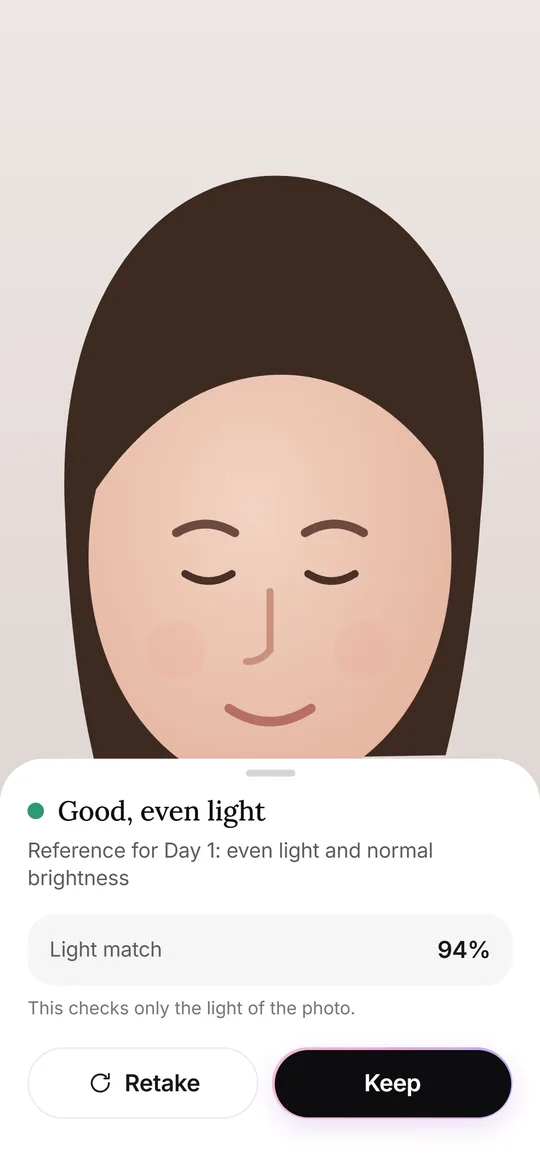
Glowproof, an iPhone skin photo diary in development, lets you pick how your skin feels from Calm, Oily, Dry, Breaking out, Sensitive or Irritated, and add context tags such as New product, Period, Poor sleep, Travel or Stress. You can tap an area on the face outline, forehead, nose, cheeks, chin or jaw, and attach your own tag or note to it. Nothing is suggested to you, and nothing is calculated from these entries. Everything you enter is shown back as you entered it. See Glow Check.
Notes and photos stay on your iPhone, with no account.
How do you read the diary back?
Once a month, scroll through the month. Read the feel words and the tags. Pick two days that looked different and read the notes around them. Ask what else was going on. Write one sentence as a conclusion, such as: rough week, bad sleep and travel, no new products. That sentence is the most useful thing the diary produces.
Why is it easy to mistake coincidence for cause?
People look for patterns, and a diary invites it. The principle that correlation does not imply causation is familiar, and it applies directly to a skin diary. Two things appearing together in your notes can reflect a third factor, chance or the way you chose what to record. Treat each pattern as a hypothesis that you could test by changing one thing for a few weeks.
Which tags should you avoid?
Avoid tags that judge you, such as bad or failed, and tags that are too broad to mean anything. A tag that applies to almost every day carries no information. A tag that you cannot decide on in a few seconds is too complicated. Keep the list short, factual and easy to apply.
What if you want to track diet or exercise?
You can add custom notes, but weigh the cost. Each new item you track makes the diary heavier. Add one thing at a time, for a defined period, and drop it if it tells you nothing. A month of notes on a single factor is more useful than a year of half-kept notes on ten.
How do you stay objective about your own notes?
Write notes before you look at the photo, when you can. Describe what you feel and what happened, not what you think it means. Use the same words each time. When you read the diary back, notice where your words and the photos disagree. That gap is information, and it is a good reason to keep the entries short and plain.
How do you review the diary with a clear head?
Pick a calm moment, not a night when you are looking at a bad patch and feeling worried. Read the notes first and the photos second. Look for what stayed the same as well as what changed. If you find yourself building a theory, write it down as a question and set a date to review it. That small habit keeps a diary from becoming a source of anxiety.
What are good habits for private notes?
Keep your notes short, dated and kind. Delete notes that you no longer need. Store them with the same care as your photos. If you share your diary with a professional, share only the part that is relevant. The notes belong to you, and they can be a calm record rather than a source of worry when you write them in plain words.
Frequently asked questions
What should I write in a skin diary?
How your skin feels in one word, any tags such as poor sleep or travel, and a short note on days when something stands out.
Do sleep and stress affect skin?
People often notice patterns, but a diary cannot prove a cause. Use tags as context and ask a professional about concerns.
How long should daily notes take?
Ten to twenty seconds. If it takes longer, shorten it so the habit lasts.
Should I track my period in a skin diary?
Some people do to watch a pattern. It is optional, and Glowproof offers it only as a tag you choose.
Does Glowproof analyze my notes?
No. It shows your entries back as you typed them and calculates nothing from them.
Keep exploring
 Glow CheckThe daily photo: guide, light check, your feel, tags and notes.Journal ideasA five-line daily entry, a weekly review, a product log and tags you can reuse.How Long to Try a New Skincare Product Before Judging ItA 14, 28 and 42 day framework for trying one skincare product, with what to write down and how to judge it fairly.Skin Photos for a Dermatologist AppointmentWhat to gather before a dermatology visit: photos, a product timeline, notes and questions, and how to share them safely.