 Glowproof
Why before and after photos can mislead, and six things to check
Before and after photos can mislead because the two shots differ in light, angle, distance, makeup, editing or timing, and any of these can look like a change in skin. To judge a pair, check that the setup matches, look for the date gap, and ask what else changed in that time.
Coming soon to iPhone
Why do before and after photos get trusted?
They look like proof. Two images side by side tell a story in a second. That speed is also why they are easy to use unfairly. A pair that shows a clear difference might show a clear difference in skin, or it might show a different lamp, a different lens distance or a different day. The viewer cannot tell without checking.
This page is not about any specific product or claim. It is about how to read a pair of photos, whether you took them or saw them online.
Trap 1: Different light
Light is the biggest source of difference in a selfie. A harsh overhead bulb adds shadow, and a soft window removes it. A warm lamp adds redness and a cool one removes it. If the before shot has strong light from one side and the after has soft light from the front, the skin can look smoother with no change at all. Look for matching shadows under the eyes and nose. Different shadows suggest different light.
Trap 2: Different angle and distance
A face turned slightly looks different. A camera held closer exaggerates the middle of the face, as the Wikipedia article on perspective distortion explains in general terms. A pair taken at different distances changes proportions, which can look like a change in skin or shape. Compare the position of the ears, the hairline and the edges of the frame.
Trap 3: Makeup, skin state and time of day
Skin looks different after washing, after exercise, in the morning and in the evening. Makeup, moisturizer or a recently applied product changes shine and color. A before photo taken at 6 pm after a long day and an after photo taken at 8 am after a night's sleep are not comparable. Ask what time each was taken and whether the skin was prepared in the same way.
Trap 4: Editing and filters
Many phone cameras smooth skin and adjust color automatically. Apps add filters. Even small changes in exposure alter how texture looks. If a photo comes from social media, assume it may have been processed. Ask whether the two images came from the same camera and the same settings.
Trap 5: Timing and cherry picking
A series of photos taken over weeks always includes good days and bad days. Choosing the worst day as the before and the best day as the after can make any change look dramatic. This is easy to do without meaning to. If you see only two images, ask how many were taken in between and who chose them.
Trap 6: Missing context
Sleep, stress, travel, hormones, weather and diet all vary. A pair of photos shows one moment and cannot tell you why it looks as it does. Notes on the days help. A line such as slept badly, or just flew back, explains a rough day without blaming a product.
What is a checklist for judging a pair?
Three or four matches give you a fair pair. One or two give you a pair that is interesting but not convincing.
| Check | Question |
|---|---|
| Light | Do the shadows fall the same way? |
| Distance | Is the face the same size in the frame? |
| Angle | Are the ears and chin in the same place? |
| Skin state | Same time of day, same prep? |
| Processing | Same camera, no filter? |
| Dates | How many days between, and what else changed? |
How do you make your own pair fair?
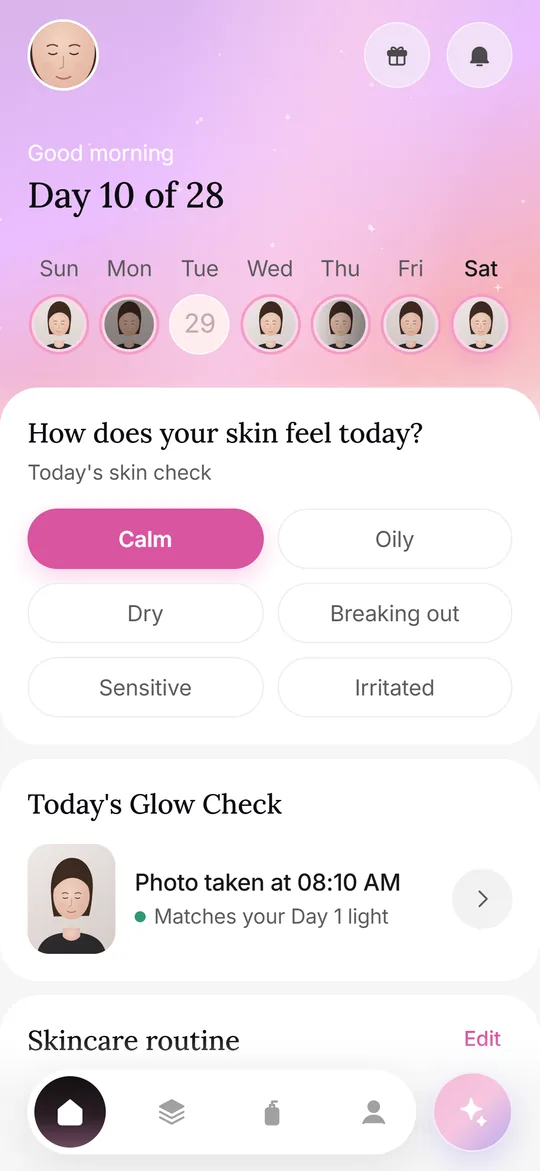
Take photos from the same spot, the same distance, in the same daylight, at the same time of day. Add a note about anything unusual. Glowproof, an iPhone skin photo diary in development, supports this with a face oval and a Day 1 outline for alignment and a light check that compares each photo with Day 1. Its Compare screen shows both dates, the number of days between them and whether the light differed, and it never describes a change in your skin. See side by side comparison. The decision about what you see stays with you, and for anything that concerns you, a qualified health professional is the right person to ask.
Are there good ways to use before and after photos?
Yes, for private use and for a conversation with a professional. A fair pair taken in the same setup, with dates and notes, helps you see slow change that the mirror hides. It also helps a clinician understand what happened between visits. The trouble comes when a pair is used to persuade someone else, because the setup is no longer visible. If you share a pair, share the dates and conditions with it.
What questions should you ask about an advert?
Who took the photos, and when? How many days apart? Were they taken in the same light and from the same distance? Was the person wearing makeup or using other products at the same time? Is there any retouching? An advert that answers these questions is more trustworthy than one that does not. One that cannot answer any of them is asking you to trust a story, not evidence.
How do you protect yourself from comparison?
Your own progress photos are about you, not about anyone else's skin. People post their best pair, and the rest of us compare our ordinary days with their highlights. If a pair makes you feel worse, step back and remember that you do not know the light, the filter or the timing. Keep your attention on your own record, taken in your own conditions.
What do professionals do differently?
In clinical settings, photographers use fixed lighting, a set distance and standard poses so that photos can be compared across visits. You cannot match a professional photo setup, but you can borrow the principle: fix everything you can and record the rest. A strip of tape on the floor to mark where you stand, a chair at the same window and a note of the time are cheap versions of the same discipline.
Where can you read more about how photos distort?
The Wikipedia article on perspective distortion is a good starting point, and many photography guides explain how focal length and distance change faces. Keep in mind that general principles apply to your phone only in broad terms, because phones combine several lenses and software tweaks. The practical lesson is always the same: keep your setup steady.
Frequently asked questions
Are before and after photos reliable?
Only when the light, angle, distance, skin state and processing match. Without those, differences may come from the photos and not from the skin.
How can I tell if a before and after photo is edited?
You often cannot. Ask whether both came from the same camera and settings, and be careful with photos from social media.
How long should the gap be between before and after photos?
It depends on what you are looking at. State the number of days next to every pair so readers can judge it.
How do I take a fair before and after photo?
Use the same spot, light, distance, angle, time of day and expression, and note anything unusual.
Does Glowproof edit my photos?
No. It stores the photo you take and compares exposure. It does not retouch or analyze your skin.
Keep exploring
 Photos at homeA repeatable home setup: spot, light, distance, angle, timing and a Day 1 reference.Consistent lightingWindow light, color temperature, flash, exposure and distance: a checklist for matching photos.Side by sideSlider or split compare, Day 7 and Day 28 moments, and old selfie vs today.Why Do I Look Different in Photos Than in the Mirror?Four reasons a photo of you looks different from the mirror, and what to keep constant so photos compare fairly.