 Glowproof
Why you look different in photos than in the mirror
You look different in photos for four reasons: a mirror shows you reversed, you are used to that version, a phone lens close to your face changes proportions, and light shifts how skin looks. None of this means the photo is wrong or you are. It matters if you compare photos over time.
Coming soon to iPhone
Reason 1: The mirror reverses you
A mirror shows a flipped image. Most faces are not symmetrical, so the version you see in the mirror has the left and right sides swapped compared with how others see you. A photo shows the unflipped version. The difference is small for some and striking for others, and it is a common reason people say a photo feels off.
Some front cameras show a mirrored preview and save the photo unflipped. That can make the saved image look different from what you framed. Know what your phone does, and be consistent about it.
Reason 2: You are used to the mirror
The Wikipedia article on the mere-exposure effect describes a tendency to develop a liking for things merely because we are familiar with them, and notes that it has been shown with pictures of faces. You have seen your mirror face thousands of times. A photo shows a version you see far less often, so it looks unfamiliar, and unfamiliar can feel worse.
That is a perception effect and not a fact about your face. It tends to fade when you look at more photos.
Reason 3: The lens and the distance
Phone lenses are wide. When a camera is close to your face, the nose and the middle of the face can look larger relative to the ears and sides. The Wikipedia article on perspective distortion explains that the appearance of an object differs from what a normal focal length would show because of the relative distances at which the image is captured. In plain terms, a close selfie and a photo taken from two meters away show the same face with different proportions.
Arm's length selfies are the closest case. If you hold the phone at the same distance every day, you get a consistent distortion, which is fine for comparison. If the distance changes, your face appears to change.
Reason 4: Light changes everything
Light direction, color and strength alter how skin looks. Light from the side casts shadows that look like texture. Light from above deepens the eyes. A warm lamp adds color, and a cool window removes it. Two selfies of the same face in two rooms can look like two people. The lighting guide explains how to keep it steady.
What should you keep constant?
If you compare photos over time, fix four things.
You will never get perfect matching, and you do not need to. The goal is to reduce the differences you control so that what remains is more likely to be real.
- Distance. Same arm's length, or a stand at the same mark.
- Angle. Camera at eye level, face straight on.
- Light. Same spot, same window, no flash.
- Expression and hair. Neutral face, hair back.
How does Glowproof help?
Glowproof, an iPhone skin photo diary in development, supports a repeatable setup. The camera screen shows a face oval and a faint outline of your Day 1 photo so that you can line up your eyes and chin the same way each day. After the shot, a light check compares brightness, left and right balance and warmth with Day 1, and tells you in a short sentence whether the light matched. It measures exposure only. It does not detect faces, measure skin tone or look for anything on your skin. See Glow Check.
What if you dislike how you look in photos?
You are not alone, and it does not mean something is wrong. Look at photos from a friend's camera or from a different distance and you will often like the result more. If the dislike is strong or affects your life, speaking to someone you trust, or to a professional, is a sensible step. A photo diary should make you feel more in control of what you see, not less.
Why do other people say you look fine?
Other people see you moving and in three dimensions, with expressions and voice. They rarely see your face flipped. They do not compare you with a mirror image, and they judge you on more than a still picture. A still photo captures a split second, sometimes a mid-blink or an odd angle. A friend's comment that you look like yourself is likely an accurate reading of how they see you.
Can you test the mirror effect yourself?
Yes, with a simple experiment. Take a photo of your face and look at it. Then flip it in an editing tool and look at that version. For many people the flipped version looks more familiar. If you want to see the unflipped version in real time, some front camera settings let you turn mirroring on or off. Try both for a few days and see which feels more natural to you. There is no right answer, only a preference.
What does this mean for skin comparison?
It means you should judge photos against other photos, not against the mirror. A change seen in the mirror this morning is not comparable with a photo from last month. A pair of photos taken in the same setup is. That is the reason progress photo routines stress consistency: they replace an unreliable comparison with a fair one. Keep the rule that every photo you compare is taken the same way.
Does the camera itself matter?
Yes. Different phones process images differently: some smooth skin, sharpen edges or brighten shadows without being asked. A photo from your current phone may look unlike one from your old phone, even in the same room. If you compare photos across years, expect some of the difference to come from the camera and its software. Within a diary, use the same phone and the standard camera settings.
Frequently asked questions
Why do I look worse in photos than in the mirror?
The mirror flips your face, you are used to that version, wide phone lenses distort a close face and light changes how skin looks.
Which is how I really look, the mirror or the photo?
Neither is the only truth. Others see an unflipped face from a normal distance, which is closer to a photo taken from farther away.
Does the front camera mirror the photo?
Some phones show a mirrored preview and save an unflipped photo. Check your settings and stay consistent.
Why does my face look bigger in a selfie?
A close wide lens exaggerates the parts nearest to the camera. Hold the phone at the same distance every time.
How can I take consistent photos?
Fix the distance, angle, light and expression, and take the photo at the same time of day.
Keep exploring
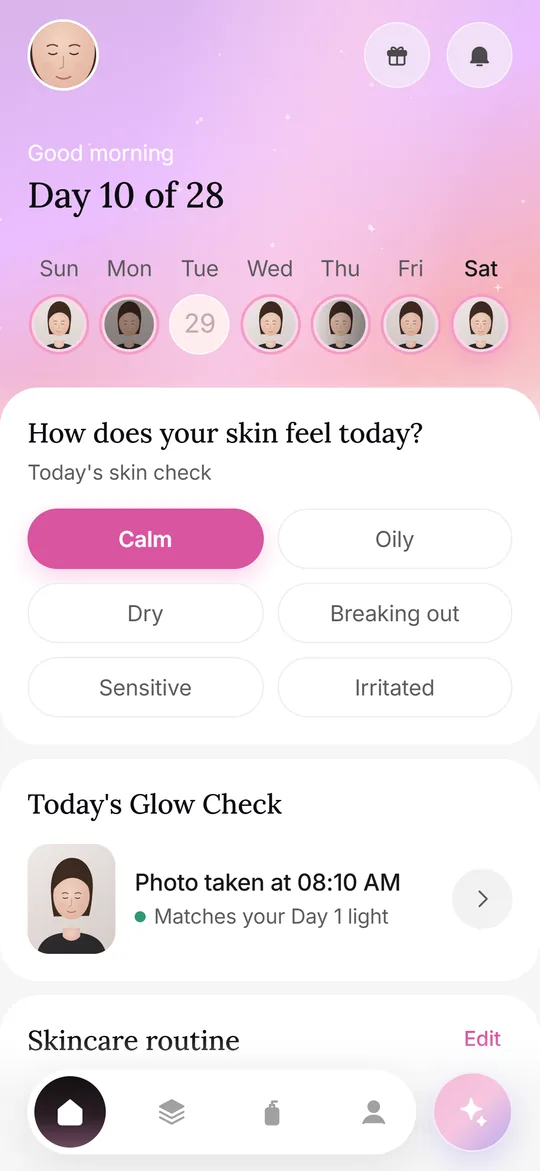 Photos at homeA repeatable home setup: spot, light, distance, angle, timing and a Day 1 reference.
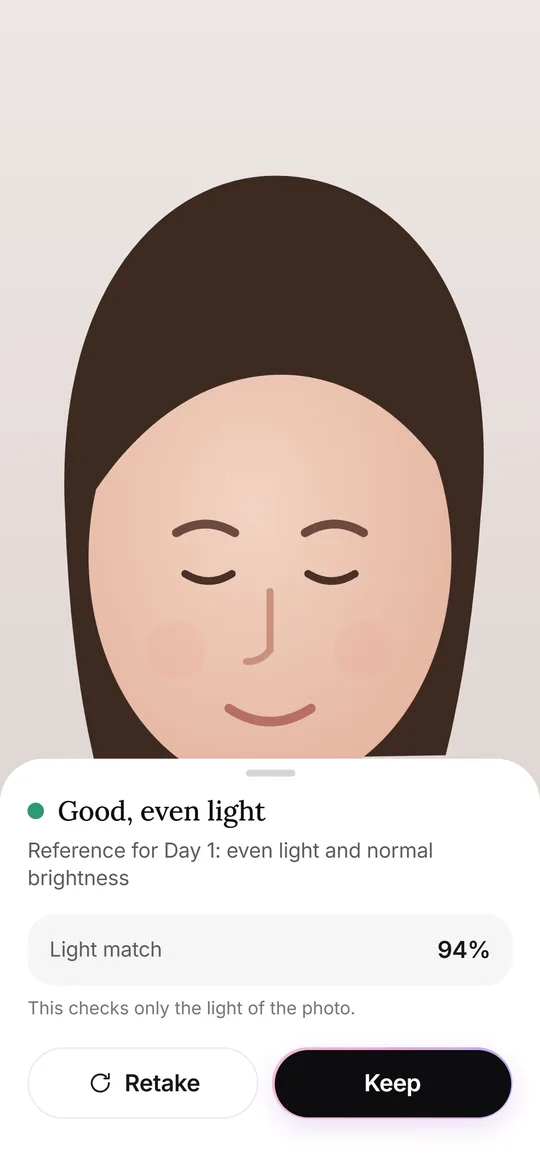 Glow CheckThe daily photo: guide, light check, your feel, tags and notes.Why Before and After Photos MisleadSix ways before and after photos mislead and a checklist for judging a pair, yours or someone else's.